The Mediaura Causal Engine · Layer 4 of Mediaura Signal
Not Attribution. Causation.
The Mediaura Causal Engine (M-CE) is the modeling layer underneath Mediaura Signal. It doesn't tell you which channel got credit. It tells you which channel actually caused the revenue, and what would happen if you spent differently next quarter.
This is the math your CFO has been asking marketing for since 2015.
Attribution Tells You Who Got Credit. Causation Tells You Who Caused It.
Every attribution platform on the market answers the same question: given a customer who converted, which marketing touches should get credit for the conversion? That's a useful question. It's not the question your CFO is actually asking.
Your CFO is asking: if we hadn't spent that $400K on Meta last quarter, how much revenue would we have lost?
Those are completely different questions. Attribution can give credit to a channel that contributed nothing. Every dollar Meta is "attributed" might have closed anyway from organic search, brand recall, or a referral. Causation isolates the dollars that wouldn't have happened otherwise. One number is a bookkeeping exercise. The other one is the truth.
The reason almost no marketing platform answers the causation question is that it's hard. It requires modeling baseline demand, isolating channel contributions from noise, controlling for seasonality and weather and cross-channel interaction, validating against real booked revenue, and (most importantly) knowing when the math isn't trustworthy and refusing to publish a number you can't defend.
M-CE is built to do all of that. And the parts that aren't built yet, we tell you about.
The Architecture
A Six-Layer Causal Modeling Pipeline
M-CE is a complete causal modeling system, not a single algorithm. Each layer feeds the next, and each layer is responsible for a different part of the trust chain that connects raw marketing data to a number you can take to your board.
All six layers run in production today against real client data across our restaurant and healthcare deployments. We flag the sixth specifically, not because it's unbuilt, but because each half carries a caveat we'd rather state than bury. Here's the honest inventory.
Signal Normalization
Eight data sources (POS, ad platforms, weather, foot traffic, call tracking, CRM, scheduling, and external market data) unified into a single 48-column daily signal table for every location in your portfolio. Runs every morning at 6 AM. If a source is missing data, the pipeline knows; if a source disagrees with another source, the pipeline reconciles. The downstream models never see broken data, because the broken data never gets out of Layer 1.
Dual-Model Architecture
M-CE runs two models in parallel for every deployment.
The Predictive Model
Uses 34 features and answers the question: given everything we know about a location's signals, what should sales look like tomorrow? Tuned for forecast accuracy.
The Causal Model
Uses a deliberately reduced 28-feature set (mediating variables that conflate cause and effect are intentionally excluded) and answers: of those sales, how many are causally driven by paid media? Tuned for unbiased channel attribution, not maximum R².
Both models use Ridge regression with rolling-origin cross-validation on an expanding window. Every metric is out-of-sample, chronologically strict. No shuffled splits. No data leakage from the future into the past.
The causal model has intentionally lower R² thresholds than the predictive model, because removing mediators reduces explanatory power, and we'd rather have an unbiased estimate of channel impact than a high-fitting model that's secretly measuring the wrong thing. We tell clients about this tradeoff explicitly, because it matters.
Adstock Modeling
Marketing doesn't work on the day you spend. An impression today drives a purchase next week. M-CE models that lag explicitly, with channel-appropriate decay curves:
Geometric adstock for Google
Appropriate for high-intent search where the click-to-conversion window is shorter and decay is monotonic.
Weibull adstock for Meta
Appropriate for upper-funnel social where impact builds before it decays, requiring a flexible shape parameter.
Hyperparameters are selected via a 120-combination grid search per channel, per location, optimized against held-out fold performance. The decay curve isn't a guess. It's fitted.
Hierarchical Pooling with Shrinkage
This is the layer that almost no other product in the market has, and it's the one we'd point a sophisticated buyer at first.
When you have a portfolio of locations, some of them have years of clean signal data and others have a few months. A standalone model on a sparse location will produce wild, unstable estimates — it'll tell you Meta's iROAS is 47x or -12x and neither number means anything. M-CE fixes this with James-Stein hierarchical pooling: every location's coefficients are shrunk toward a portfolio-wide prior, with the shrinkage factor determined by how much signal that location actually has.
Translated: if a location doesn't have enough data to trust its own estimate, M-CE borrows strength from the rest of your portfolio, and tells you exactly how much it borrowed. The shrinkage diagnostics are auditable. You can see, for every coefficient, how much came from the location's own data and how much came from the portfolio mean.
This is also where market-type covariates come in. A tourist-heavy location and a suburban commuter location should not pool toward the same prior, because their underlying demand patterns are different. M-CE pools within market types, not across them.
Robyn doesn't do this. Meridian doesn't do this. No SaaS MMM tool we're aware of does this. It's the difference between a model that works for big brands with massive single-location data and a model that works for the actual structure of multi-location businesses.
Daily Prediction and Lift Decomposition
Once the models are trained and stable, M-CE generates daily outputs for every location:
Baseline forecast
What sales would have looked like with no paid media
95% prediction interval
The model's confidence band, not a single point estimate
Per-channel incremental lift
How much Google contributed, how much Meta contributed, in actual dollars
iROAS
Daily lift divided by daily spend, per channel
Residual
Actual sales minus baseline forecast, with a percentage error
Full diagnostics
All coefficients and stability diagnostics, fully auditable
The baseline forecast is the counterfactual. The lift is what wouldn't have happened without the spend. The residual is your model's honesty score.
Incrementality Experiments and Budget Optimization
The sixth layer is live. Two capabilities, each with a caveat:
Incrementality experiments
We measure incrementality against real client data today. The engine treats real events, a campaign launching or a budget pausing, as natural experiments and cross-checks the causal lift against the MMM's prediction. On a live deployment, one channel launch landed within about 4% of the model's forecast; a separate check caught the MMM over-crediting a channel. The engine uses the design that fits the business: natural experiments where they're cleanest, geo-holdouts for multi-location footprints. The one test we haven't run end to end yet is a deliberately-designed dark-market geo-holdout. The machinery is in place; we run it when a client's footprint makes it the right call.
Budget optimization
Live, directionalGiven a budget across channels and locations, the engine computes the allocation that maximizes incremental revenue, using constrained optimization over the MMM's channel effects. It runs on real MMM output today and is available inside the analyst. Its one honest limit: the saturation curves are modeled, not yet measured, so today the recommendations are directional. Measuring those curves is exactly what the incrementality program in the other half of this layer is for.
The two halves are linked. Budget optimization runs today on modeled curves; incrementality measurement is how those curves get replaced with real ones; the recommendations sharpen every time we run a test. We'd rather tell you the optimizer is directional today than pretend it's precise.
Validation
How We Know the Numbers Are Real
Every causal model on the market produces numbers. The question that separates the trustworthy ones from the rest is: how do you know the numbers aren't garbage? Here's the full validation story M-CE runs against every model before it's allowed to publish a single output.
The Future-Spend Placebo Test
This is the test we'd want every causal modeling product on the market to be required to run, and as far as we know, none of them do. The diagnostic is simple to describe and devastating to fail:
We regress today's sales on tomorrow's spend.
A model that's actually detecting causation should find no relationship; tomorrow's spend can't possibly cause today's sales. A model that's secretly just measuring "spend follows demand" (which is most marketing models, because brands spend more in busy seasons) will find a strong relationship, because the demand signal leaks both directions.
If M-CE's future-spend placebo test fires, the model is rejected. Not flagged. Rejected. The only models that get to publish numbers are the ones that pass a test that's impossible to game.
The Stability Gate
Live in productionFor every channel coefficient M-CE produces, it computes the coefficient of variation across cross-validation folds and checks the sign consistency. If the coefficient is unstable across folds (CV > 1.5), or if the sign flips between folds (sometimes Meta is positive, sometimes Meta is negative), the model is rejected.
M-CE refuses to publish a number it doesn't trust. A SaaS MMM tool will hand you a coefficient and let you decide what to do with it. M-CE will tell you "we don't have enough signal here yet" and suggest waiting for more data or pooling more aggressively from your portfolio.
This is the single most important property of the system. Every other validation step is downstream of the stability gate.
The Full Diagnostic Battery
Live in productionIn addition to the placebo test and the stability gate, every M-CE model run produces a complete diagnostic panel:
Bias check on low-spend days
Does the model overestimate lift when spend is near zero? (It shouldn't.)
Smoothing check
Are the lag-peak alignments consistent with channel behavior?
iROAS sanity check
Any iROAS estimate above 25x is flagged for review. Real iROAS that high is rare; usually it's a model artifact.
Hierarchical pooling diagnostics
Full audit of how much each location's coefficients moved during shrinkage and why.
Backtest against booked revenue
Historical residuals can be backfilled at any point and compared against actual sales over any window. The counterfactual is testable, not theoretical.
What's Coming
In active developmentAutomated platform reconciliation
Comparing M-CE's lift estimates against Meta's and Google's self-reported attribution side-by-side, in a live report. The data is already in the pipeline; the report layer isn't built yet.
We frame the existing validation as: what you'd run before the experiment to know the experiment is worth running. The placebo test, the stability gate, and the diagnostic battery don't replace experimental validation. They earn the right to run an experiment, and they prevent the much more common failure mode of publishing causal claims that wouldn't have survived an experiment if you'd bothered to run one.
The Output
Three Surfaces, One Engine
M-CE produces a lot of math. The question is how a customer actually consumes it. Today, M-CE outputs surface in three places:
The Attribution Dashboard
A live view of every model in your portfolio: status, R², median absolute percentage error, average lift per location, trend charts showing baseline forecast vs. actual sales with the lift overlay highlighted. Every coefficient is auditable; every diagnostic is one click away. This is the dashboard your marketing analyst lives in.
Aura, the AI Analyst
"Aura, what did Meta contribute to the Fishers location last month?"
Aura answers in plain English, but the answer doesn't come from the language model guessing. Aura calls into M-CE's prediction tables, pulls the actual lift estimate, references the relevant stability diagnostics, and explains the result in a sentence.
"M-CE has Meta's contribution at the Fishers location at $34,000 last month, but the stability gate flagged this coefficient as borderline; I'd treat that number as directional until next month's retrain."
This is what we mean when we say Aura doesn't do the math. M-CE does the math. Aura calls M-CE and explains the answer.
The Weekly Insights Report
Every Monday at 7 AM, Aura generates a narrative report that weaves M-CE findings into a plain-English summary of the week: which channels drove incremental revenue, which locations are over- or under-performing their baseline, which coefficients moved meaningfully, and what to do about it. Delivered to your inbox before your Monday standup. Built from the same M-CE outputs, just packaged for an executive who doesn't want to log into a dashboard to read them.
Healthcare adds a fourth surface: Scenario Forecasting
In productionFor our behavioral health deployments, M-CE feeds a scenario forecasting interface tied to the admission funnel: "if I spend $X on Meta for the next 30 days, how many leads, verified-benefit cases, and admissions should I expect?"
The funnel conversion rates are learned from your facility's historical data; the spend-to-outcome projection comes from M-CE's causal coefficients. This is in production today for two facilities.
Operations
The Cadence
A common failure mode of "AI marketing platforms" is implying everything is real-time when it isn't, and then quietly producing stale numbers in the background. Here's the actual cadence M-CE runs on, and why each piece runs when it does.
Signal layer: nightly at 6 AM ET, fully automated
Every data source is pulled, normalized, reconciled, and written to the unified signal table before anyone in your organization is awake. By the time your team logs in, the previous day's data is already clean.
Daily predictions: automatic, every morning
As soon as the signal layer has fresh POS data, M-CE generates updated baseline forecasts and lift estimates for every location. Yesterday's lift number is waiting for you when you sit down at your desk.
Model retraining: monthly, with a Mediaura analyst in the loop
This is intentional, and we want to be clear about why. We could fully automate retraining. We don't. Every monthly retrain runs through the stability gate, the diagnostic battery, the future-spend placebo test, and the hierarchical pooling diagnostics, and a real analyst reviews the output before new coefficients are activated.
This is a feature, not a limitation. The math runs by itself. The decision to trust the math doesn't.
Aura queries: on-demand, anytime
Every time you ask Aura a question, it pulls the latest M-CE outputs from the prediction tables and answers from real, current data, not from cached summaries.
Weekly Insights: every Monday at 7 AM, automated
Built from the same M-CE outputs as the dashboard, packaged as a narrative.
Robyn, Meridian, and M-CE: How They Work Together
Robyn (open-source from Meta) and Meridian (open-source from Google) are excellent MMM libraries. The math inside both is credible and they've raised the floor for the entire industry. Mediaura Signal runs both, not instead of M-CE, alongside it, as engines in the four-method reconciliation.
Here's how the engines divide the work.
M-CE answers the causal question
The dual-model architecture, hierarchical pooling, future-spend placebo test, and stability gate together produce honest causal estimates per channel per location, with confounding controlled by design. This is the question Robyn and Meridian can't answer at the location level for a multi-location, multi-tenant business, because they don't pool across portfolios and they don't reject their own unstable output.
Meridian and Robyn answer the strategic question
How should the channel mix combine across a portfolio? What's the saturation curve for paid search? What's the adstock half-life for CTV? These are MMM's strong suit, and the open-source libraries do them well. We run both engines in parallel; their agreement on a channel itself becomes a confidence signal in the fused output.
The reconciliation engine combines them
When M-CE, Meridian, Robyn, and the funnel/journey views all produce channel-level estimates for the same period, the reconciliation engine anchors them to experimental ground truth (via M-CE's incrementality outputs and natural-experiment detection), fuses them into a single posterior with quantified confidence, and surfaces method disagreement when it exists. Quality gates exclude blown-up fits before they reach the fusion: the same kind of "refuses to publish numbers it can't defend" discipline that M-CE applies internally, extended across all engines.
The output: one defensible number per channel per outcome per period, with the four supporting estimates one click away, the confidence interval visible, and the method-agreement score showing how much the layers agreed before the number was published.
Where Robyn and Meridian fall short as standalone systems
These are the gaps the M-CE engine and the reconciliation layer fill.
They don't reject their own output.
Run Robyn on a sparse dataset and it'll happily produce coefficients that are noise. The reconciliation engine's quality gates exclude fits where implied incremental exceeds observed revenue, where the CI is wider than 10× the point estimate, or where the channel contribution share is negative or above 100%.
They don't pool across your portfolio.
Both assume one entity at a time. M-CE's James-Stein hierarchical pooling fills the gap with auditable shrinkage diagnostics.
They don't run a future-spend placebo test.
M-CE tests for reverse causality explicitly and rejects models that fail. Robyn and Meridian quietly inherit the bias.
They don't have a signal layer underneath them.
Both assume clean, normalized daily marketing data. Signal Tracker and the Signal pipeline produce it.
They don't have an AI layer on top of them.
Robyn outputs are CSVs and PDF reports. The reconciled outputs feed Aura, which means anyone in your organization can ask a causal question in plain English and get an answer sourced from real coefficients with real diagnostics attached.
They don't enforce decision routing.
A fused MMM number used to decide whether to pause Meta today is exactly the failure mode the Signal UI prevents by tagging numbers with their valid decision context (strategic, tactical, operational) and refusing to surface the wrong one for the wrong question.
Robyn and Meridian are libraries. M-CE is a causal modeling engine. The reconciliation layer is the operational system that combines them, designed to work with whatever team is running your marketing: your current agency, your in-house team, or Mediaura itself.
Production Deployments
Refined Against Real Client Data
M-CE wasn't built in a lab. Every layer has been refined against live revenue data from pilot deployments across two verticals, with three production clients running today:
Multi-location restaurant
LiveEight data sources unified into a single daily signal layer; dual predictive and causal models trained per location with hierarchical pooling across the portfolio; daily lift decomposition feeding the attribution dashboard and Aura. This is the deployment that hardened the stability gate, the placebo testing, and the market-type covariates for tourist vs. suburban locations.
Behavioral health, two facilities
LiveThe same core engine, plus scenario forecasting tied to the admission funnel (lead → verified benefit → admission). This is the deployment that proved M-CE could operate in a HIPAA-compliant pipeline and that the causal coefficients held up against the longer, higher-stakes conversion windows of healthcare.
B2B professional services
Attribution live Causal layer in developmentAttribution layer is live in production today (Weibull adstock decay, campaign matching, deal-level classification, full dashboard, and Aura). The full causal modeling layer for long-cycle B2B deals is in active development; long sales cycles require additional modeling work that we're rolling out through 2026.
We're not selling M-CE as a polished SaaS product because it isn't one yet. We're offering it as the modeling engine inside a Mediaura Signal engagement, refined against real client data, with the diagnostic transparency to prove the numbers. As we onboard new clients, the system gets sharper.
Layer 4 of a Four-Layer System
M-CE is the deepest layer of Mediaura Signal, and it sits on top of three layers that have to work first:
Signal Tracker
Captures clean signal at the source
Identity Resolution
Stitches the journey into one customer
Revenue Mapping
Ties that customer to actual booked revenue
The Mediaura Causal Engine
Runs the causal models on top of all of it
And Aura, the agentic AI analyst, sits across all four layers, calling into each one when you ask a question, and explaining the result in plain English.
You cannot build a credible causal engine on top of a broken signal layer. You cannot model lift without first knowing which transactions are real and which are duplicates. You cannot pool across a portfolio if you can't reconcile the customer records. M-CE works because the three layers below it work first. That's the entire architectural argument for Mediaura Signal as a system rather than a collection of features.
Above the Stack
Above the four layers: the reconciliation engine
The four-layer Signal stack produces clean signal, stitched identity, mapped revenue, and causal estimates. The reconciliation engine takes M-CE's causal outputs, MMM outputs from Meridian and Robyn, multi-touch attribution evidence where applicable, and funnel data, and combines them into a single defensible number per channel per outcome per period, with confidence intervals, method-agreement scoring, and decision-routing enforcement in the UI.
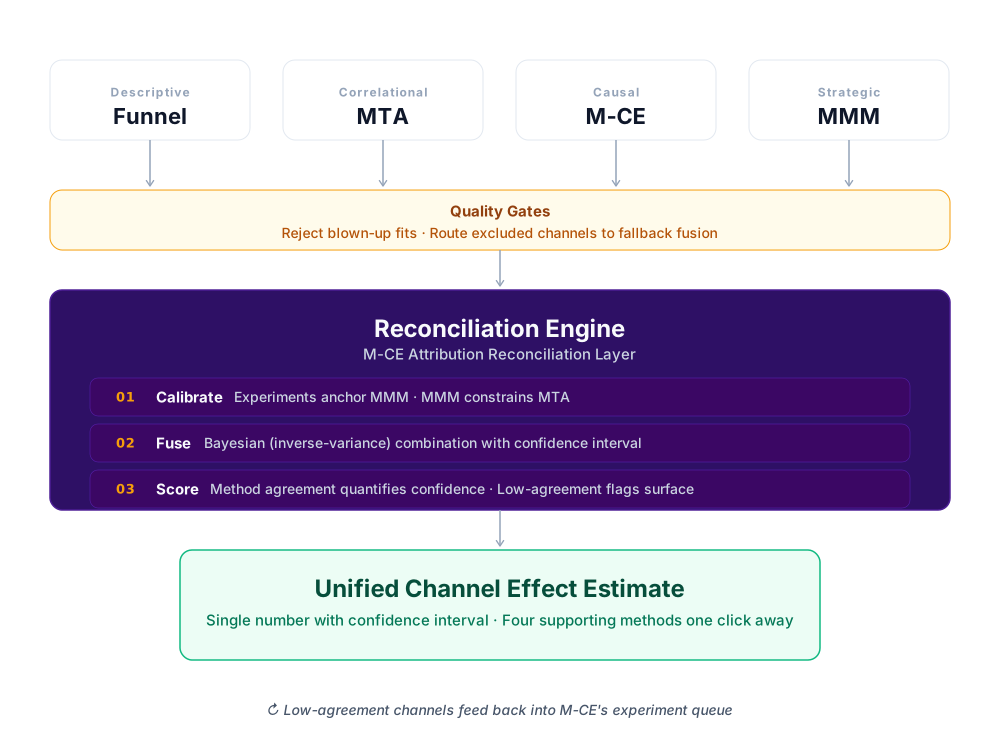
M-CE is the causal anchor; the reconciliation engine is how that anchor calibrates the rest of the measurement stack into one number you can defend to a board, a CFO, or a skeptical client. It's the layer above the stack, not inside it.
See M-CE Run Against Your Data
The fastest way to evaluate M-CE is to see it run against a slice of your actual marketing data. We can stand up a pilot deployment in a few weeks and produce the first round of dual-model outputs, stability diagnostics, and lift decomposition before a full engagement begins.
What happens next:
- 30-minute working session with a Mediaura engineer and a data scientist
- Walkthrough of the M-CE architecture and the validation pipeline
- Discussion of what a pilot deployment would look like for your business
- Sample outputs from comparable production deployments (anonymized)